Being in the "business" as it were, I get the semi-occasional email asking what kind of digital camera should be purchased.
It's a really tricky question, and I hate not to answer it, so here's what I generally say.
Point and Shoot cameras
If you're just looking for a point-and-shoot camera you can take everywhere, go for Canon. That would almost be heretical, as I use Nikon equipment. But I'm with Thom Hogan on this one: Nikon may make great SLR bodies and lenses, but their Coolpix line of point-and-shoot cameras is pathetic. I didn't know this until recently, but they subcontract to Sanyo to produce the Coolpixes, presumably because it's a stable line of income and if they didn't have point-and-shoot cameras, people wouldn't know to upgrade to SLRs. Anyway, Canon produces a solid point-and-shoot camera; I bought one for my Dad some years back, probably the Powershot A80, and it does everything he needs (and possibly stuff he doesn't), runs on AA batteries, and has a folding LCD screen.
That said, there are (of course) other alternatives worth considering. If you're already in the Sony camp, and have a memory stick or two, then it's worth considering their Cybershot lineup. The cameras keep getting smaller and smaller with more and more features.
If you need a camera that can survive drops, water, dust, sand, snow and children, you might want to consider the Olympus Stylus lineup - they've put a lot of effort into bombproofing the camera. Other than that, it's fairly unremarkable. The Pentax Optio series is also waterproof, but not as survivable.
Casio also makes a very slim, transportable camera - the Exilim series - which is infinitely portable, and will serve well.
If you're looking around and have time to spare, it does come down to how the camera feels in your hand, the intuition factor if you will - and what kind of deal you can get for it. When it comes to point-and-shoot digicams I support buying new where possible, or refurbished. Buying used isn't necessarily a great idea unless you know the previous user personally.
If you're in an airport and need to go with something immediately, you can't go wrong with the Canon Powershot SD1100. Great price, great camera, does everything and well. Canon is selling a zillion of these and for good reason.
When all is said and done, you should be able to get into a good point and shoot for $200-400 dollars.
Digital SLR (Single-Lens Reflex) cameras
Careful now. This gets complicated.
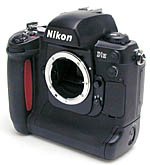
When we talk about digital SLRs, we're talking about those cameras where you can switch the lens. The cameras you see at sporting events and wildlife sanctuaries, where the lens can be many times larger than the camera. And many times more expensive. These cameras have many advantages over regular point and shoot cameras, but also many disadvantages.
Before even contemplating getting one of these things, keep in mind a few things.
1. It can get expensive. Camera companies may push the body, but that's only half the equation; the lens can be just as expensive, if not more, or much more.
2. A point-and-shoot camera can go with you anywhere in your coat pocket; a whole SLR camera system (body, a couple of lenses, flash, tripod) needs a pack of some kind, and isn't as convenient.
3. A point-and-shoot camera, when used properly, could give you about 80% of the quality of the image produced by a SLR camera (obviously that number is highly debatable, depending on the camera and the situation). The point is that there is a lot of technology embedded in today's point and shoot cameras.
4. Digital SLR camera bodies depreciate rapidly in value; see my previous post.
If none of this has scared you off, here are the advantages:
1. SLR cameras, with the right lens, can give you optical effects that are impossible with point and shoot cameras (blurred-out backgrounds common in portraits, large-scale macro shots, super-fast shutter speeds, etc.).
2. Focus time with SLR cameras is dramatically better compared to point-and-shoot cameras; if you've ever missed a moment because the P'n'S was busy focusing, you've experienced this.
3. SLR cameras offer much more advanced functionality for dealing with difficult shooting scenarios.
And many more, obviously.
In terms of what to buy here, it's actually less complicated than you think. The basics of the buying choice start with a few factors:
1. Do you have any existing camera gear? For example, an old Pentax film body with a few lenses? If so, you may want to use the old lenses on a new digital body, ie., you already have an investment in lenses that you won't lose by starting over in a new brand.
2. What's your budget? Count on a beginner system costing you around $600 minimum, to upwards of $1,000.
3. How comfortable are you with buying used? If you're not concerned with trifling things like warranties, then you can save a bundle by buying used, where a two-year old camera can be 50% or less of its original value.
After this, it comes down to what feels comfortable for you. At this level of camera, they all produce excellent images, and there are very few lemons. Different companies showcase different technologies and embody different opinions regarding how images should be made: what is important to one may be completely missed by another.
So I won't come down one way or another with a recommendation on SLR camera gear, other than to say that I shoot Nikon, and enjoy it very much.
As a final note on selecting cameras, I'll point you to The Imaging Resource digital camera advisor, which is actually a very good tool for helping you to narrow down your choices:
The Imaging Resource Digital Camera Advisor




2 hours ago


